
FootBiz Newsletter No. 211: The People Who Held Lyon’s Debt Ended Up Owning Lyon
Lyon’s creditors take control, Porto faces a €130m annual funding gap and the Saputo family puts Montréal up for sale. Plus Wrexham, Real Madrid, Cádiz and Marseille.
November 10, 2026
Good morning.
Six months into the administration of the company that owned Olympique Lyonnais, the administrators have reported back. The buyer and the lender turned out to be the same people, the outside creditors shared $61,604 and the professionals billed more than the estate collected. Elsewhere Porto’s finance director has set out what it costs to be champions of Portugal, the Saputo family is selling Montréal after 34 years and Wrexham have parted with the chief executive who took them to the Championship.
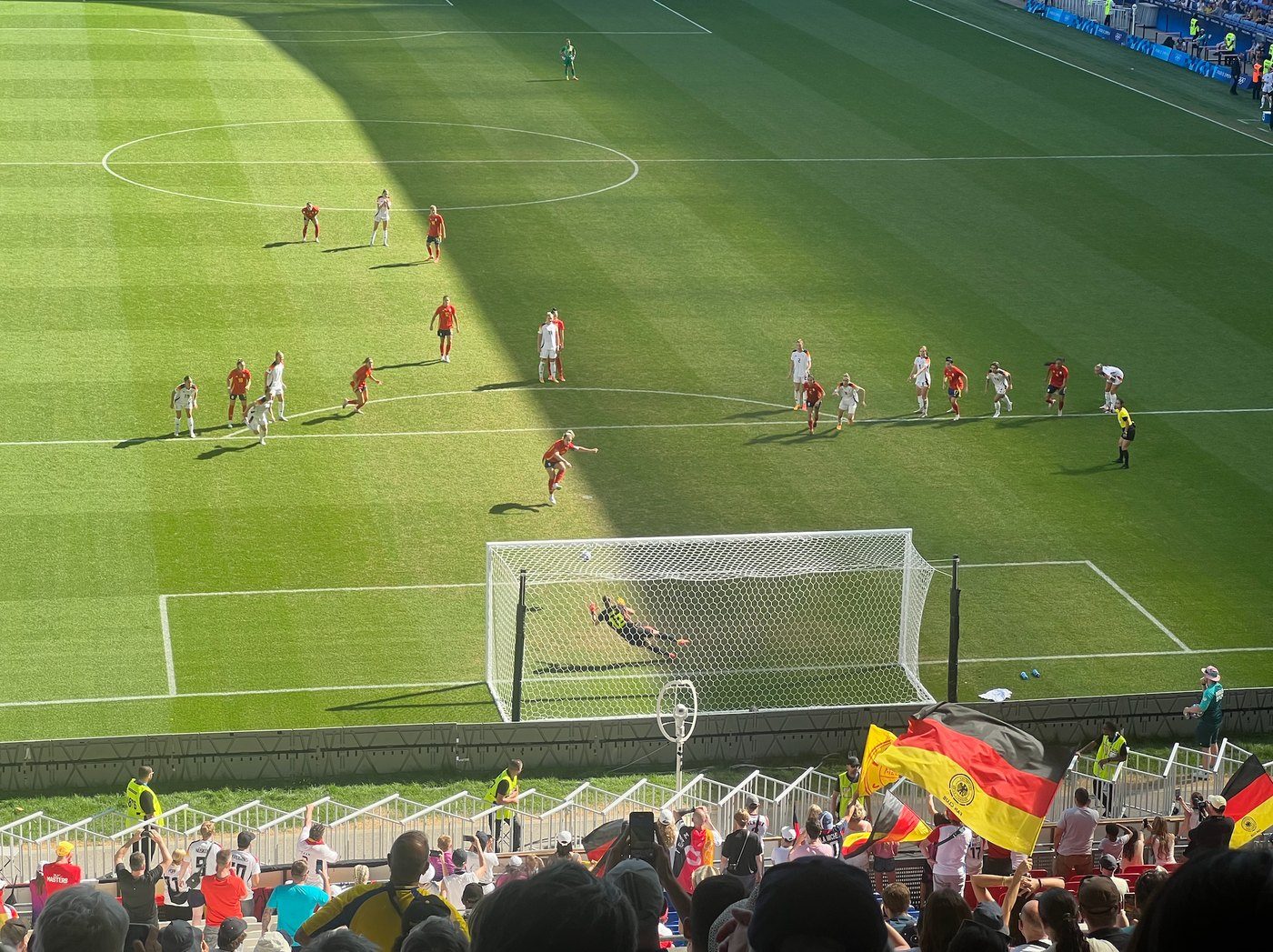
Groupama Stadium, Lyon, during Spain–Germany’s Olympic bronze-medal match, 9 August 2024.
Photo: LHC88 · CC BY 4.0 · JPEG conversion and compression.

Six Months in Administration, $61,604 for the Outsiders
When John Textor’s Eagle Football Holdings Bidco went into administration in March, it owed its secured creditors $547.4m and owned 87.78% of the company that owns Olympique Lyonnais. By the time Cork Gully’s six-month report closed on 26 September, that stake had been sold for $30m to Olympe Bidco, Michele Kang’s vehicle.
Before the sale, Kang’s holding company YMK had bought up a majority of Bidco’s secured notes, so when Olympe Bidco paid $30m for the shares about $17.9m of it went straight back to reduce YMK’s own secured debt. The Esk, whose analysis of the report appeared on Saturday, calls it a credit-bid recapitalisation rather than a cash sale. Noteholders outside Kang’s group were left with $61,604 to share. Unsecured creditors owed about £87.8m are expected to get nothing at all.
The administrators recorded the sale as a connected-party transaction and took an independent valuation before approving it. The Esk believes the paperwork was faultless but the substance was not, since the party enforcing the debt and the party buying the asset had been one and the same from the moment the administration began. What YMK paid for the notes has never been disclosed. That number, not the $30m, is the real price of Lyon.
The estate collected about £1.55m excluding borrowed funding. The administrators charged £2.14m and the lawyers £1.30m, with a further £688,000 lost to irrecoverable VAT. RWDM was sold for €1 on 31 July to Thierry Dailly, the Brussels club’s former president. The administrators say the records they were given were too thin to let them investigate properly and they have brought no claims to recover anything on behalf of creditors. Their report on how the directors conducted themselves has gone to the Insolvency Service, where it stays confidential.
The report accepts that Kang was conflicted, since she chaired Eagle Football Group while holding its secured debt through YMK. Textor said in August that Dailly could not have bought all of RWDM because capital increases in 2023-24 had moved part of the club outside Bidco, yet the administrators record Bidco holding 99.5% of it when they were appointed. Textor has also claimed that Bidco’s 90% of Botafogo became his personally after a default judgment in Florida. The administrators record the shares as still belonging to Bidco and note that Textor’s own letter of 26 January described Bidco as the majority shareholder.
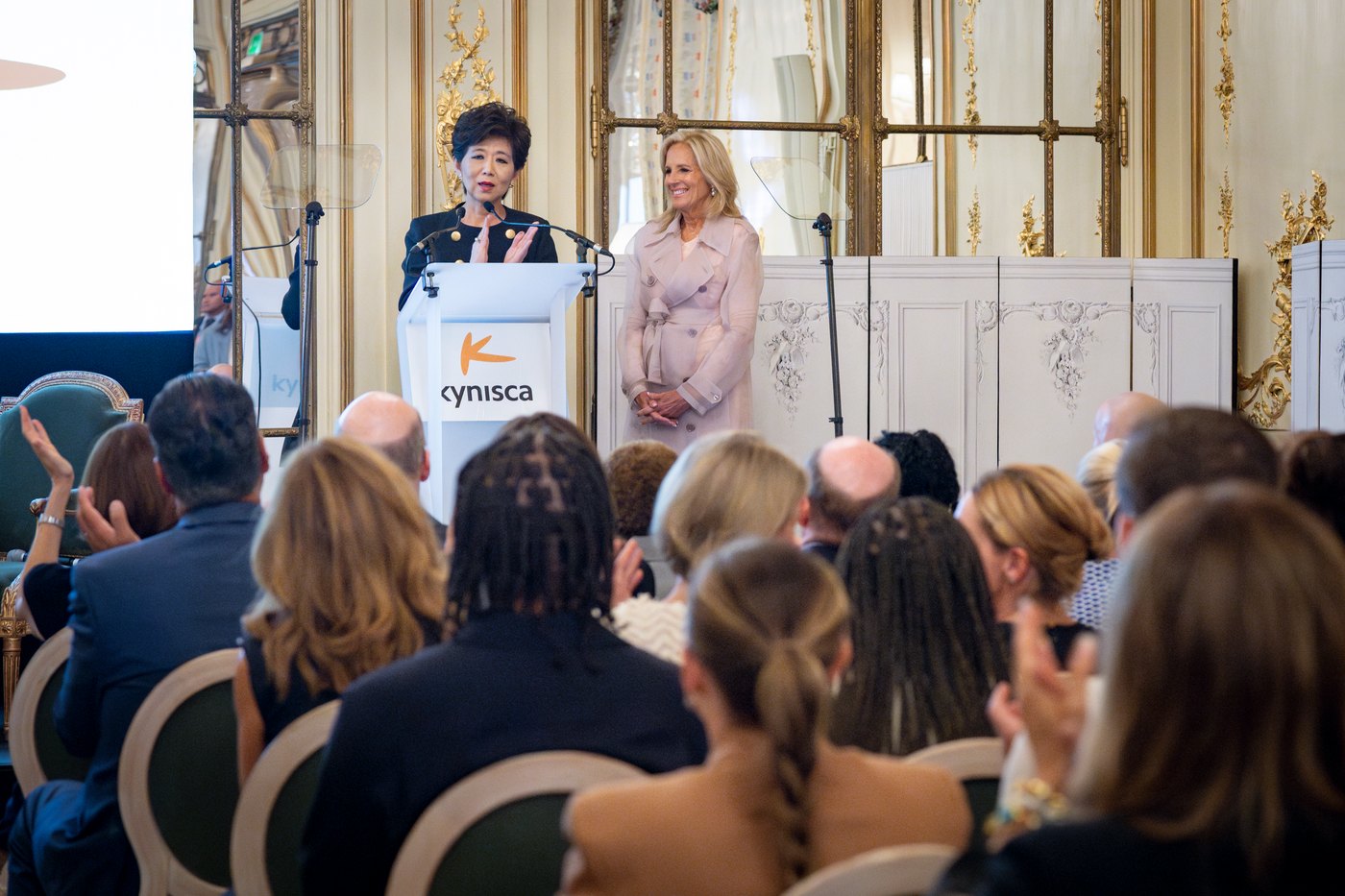
Michele Kang speaking at a women’s health event in Paris, 27 July 2024.
Photo: Erin Scott / The White House · Public domain (US federal government) · JPEG conversion and compression.

The administration has dealt with Lyon’s holding company but not with Lyon’s balance sheet, where consolidated equity stands at minus €248.3m. French takeover law now obliges Kang to make an offer for the shares she does not own at a price anchored to the €0.1713 a share she paid for control. When the financial year closed on 30 June the shares were trading at €1.80.
Porto Must Find €130m a Year Before They Break Even
Porto have to find about €130m a season from European prize money and player sales before the club breaks even, according to Pereira da Costa, chief financial officer of the SAD, in interviews with ECO, A Bola and O Jogo on Monday. Last season the Europa League brought €23m of revenue while player trading accounted for €55.9m. Even so, the champions of Portugal finished the year with a consolidated net loss of €21.1m. The previous year they had made €41m, helped by €24m of one-off income from the sale of the insurer Porto Seguro and a payment from Ithaka, the stadium partner.
Before UEFA revenue the club’s operating deficit is about €50m a year, down from €65m two years ago, an improvement Pereira da Costa attributes to ticketing, hospitality, advertising and merchandising. Player amortisation and financing costs add roughly €80m to that. A Champions League campaign is worth €60m to €70m to Porto and Pereira da Costa said that missing it costs €40m to €50m in direct revenue before the knock-on effects on ticketing and player values.
The club’s debts to other clubs rose 51% in the year. Porto are raising money from retail investors through a bond issue of €40m, which Pereira da Costa hopes to increase to €55m so that all of the debt falling due in December can be repaid. He ruled out a capital increase. UEFA requires Porto’s negative equity to improve by 10% a year, measured each December. So far the capital injected by Ithaka and a revaluation of the Estádio do Dragão have done most of that work and a suspended UEFA sanction expired in June without a further breach.
Portuguese clubs currently sell their own TV rights and are due to move to collective selling from 2027/28, and Pereira da Costa thinks it very unlikely that Porto will receive more money as a result.
Porto spent €37m on players in the summer, down from about €110m a year earlier, and brought in €78m from sales. The largest was Rodrigo Mora, valued at €50m in a deal that took him to Roma for €25m in exchange for half of his economic rights, with Porto holding an option over the rest. “I am not a sporting director,” Pereira da Costa said of it. “For me it is a financial sale.” Selling players is one thing, he added, and being forced to sell them is another, and Porto are no longer in that position.
Bologna Owner Saputo Puts Montréal Up for Sale With Vancouver Still Unsold
Joey Saputo announced on Monday that he has appointed BMO Capital Markets and National Bank of Canada to sell CF Montréal, the club his family has owned since it was founded as the Montréal Impact in 1992. Sportico values the club at $430m, down 4% on the year and the lowest in MLS. Montréal finished last in the whole league this season with six wins, eight draws and 20 defeats, seven points behind the next club in the Eastern Conference. Average attendance was 14,875, the second lowest in MLS.
Saputo said he wants a buyer who takes full control of the club and that Québec investors will be given the first chance. If none comes forward he will accept an offer that moves the club, subject to league approval. Saputo has owned Bologna since 2014 and there is nothing in the market to suggest the Serie A club is for sale.
Vancouver Whitecaps have been for sale since December 2024 with Goldman Sachs running the process. More than 100 parties made contact and more than 30 went into the data room, yet chief executive Axel Schuster told Sportico that none wanted to buy “even 1%” of the club and said in September that nothing had changed. San Jose, who hired Moelis this year, have drawn tepid interest at $585m.
The Whitecaps have no agreement to play at BC Place beyond this season and a memorandum signed with the city in September to explore a stadium at Hastings Park runs only to 31 December. The one formal offer that has become public, from a group led by Grant Gustavson, son of the billionaire Tamara Gustavson, would move the club to Las Vegas.
Don Garber has called the BC Place arrangement untenable and said the league wants the club to stay, but the decision will not be his. He hands over on 1 January to Larry Berg, the former Apollo partner who is selling his stake in LAFC before he takes office.
MLS clubs generated about $2.5bn of local revenue last year, $83m each on average, and seven of them passed $100m. Montréal, Vancouver and Colorado each took in between $35m and $40m. Sportico reports that the Apple deal, which averaged about $250m a year before it was revised last November, nets each club around $5m after production costs.
Wrexham Part Ways With Their Chief Executive
Michael Williamson left Wrexham on Friday afternoon in a 139-word statement from Ryan Reynolds and Rob Mac that thanked him for two years’ work. Phil Parkinson had been told that morning. Most of the staff found out shortly before the announcement and Williamson’s notes still ran in Saturday’s programme for the Wolves match. Shaun Harvey, who ran the EFL from 2013 to 2019 and has advised Reynolds and Mac since 2021, joining the board in November 2023, has been appointed acting chief executive with immediate effect. A permanent appointment would need the Independent Football Regulator’s approval.
Williamson, an American who arrived with experience at Inter Milan, DC United and Miami FC, joined Wrexham in May 2024 after promotion to League One. He presided over promotion to the Championship, followed by a seventh-place finish in the second tier last season, a rise in staff from 255 to 313, Category 3 academy status and the £69m Kop Stand due to open next year. Turnover for the year to June 2026 is expected at between £46m and £50m against a record £33.3m the year before. A year ago this month he was named Football Industry Leader of the Year.
Wrexham were the last of the 24 Championship clubs to make a summer signing. Two of the seven who eventually arrived came on deadline day and the EFL ruled that two of them, Callum O’Hare and Issa Kaboré, had been ineligible, fining the club £75,000 with £25,000 suspended. A £10 Fanzone surcharge was scrapped after a backlash. Wrexham merchandise carrying a white dragon was withdrawn after supporters pointed out that in Welsh legend the white dragon is the Saxon invader beaten by the red dragon on the Welsh national flag, a story the club’s own documentary had told in an episode called Red Dragons.
Humphrey Ker has stepped down as a director and the club has been without a secretary since Geraint Parry left a year ago. Steve Nickson, hired from Newcastle as sporting director earlier in the season, only started after the window closed.
On Saturday the fans applauded Harvey to his seat and Paul Mullin, Elliot Lee and other players who had left under Williamson were among those liking BBC Sport Wales’s post about his departure. The owners’ statement said the club remained focused on making the Wrexham community proud.
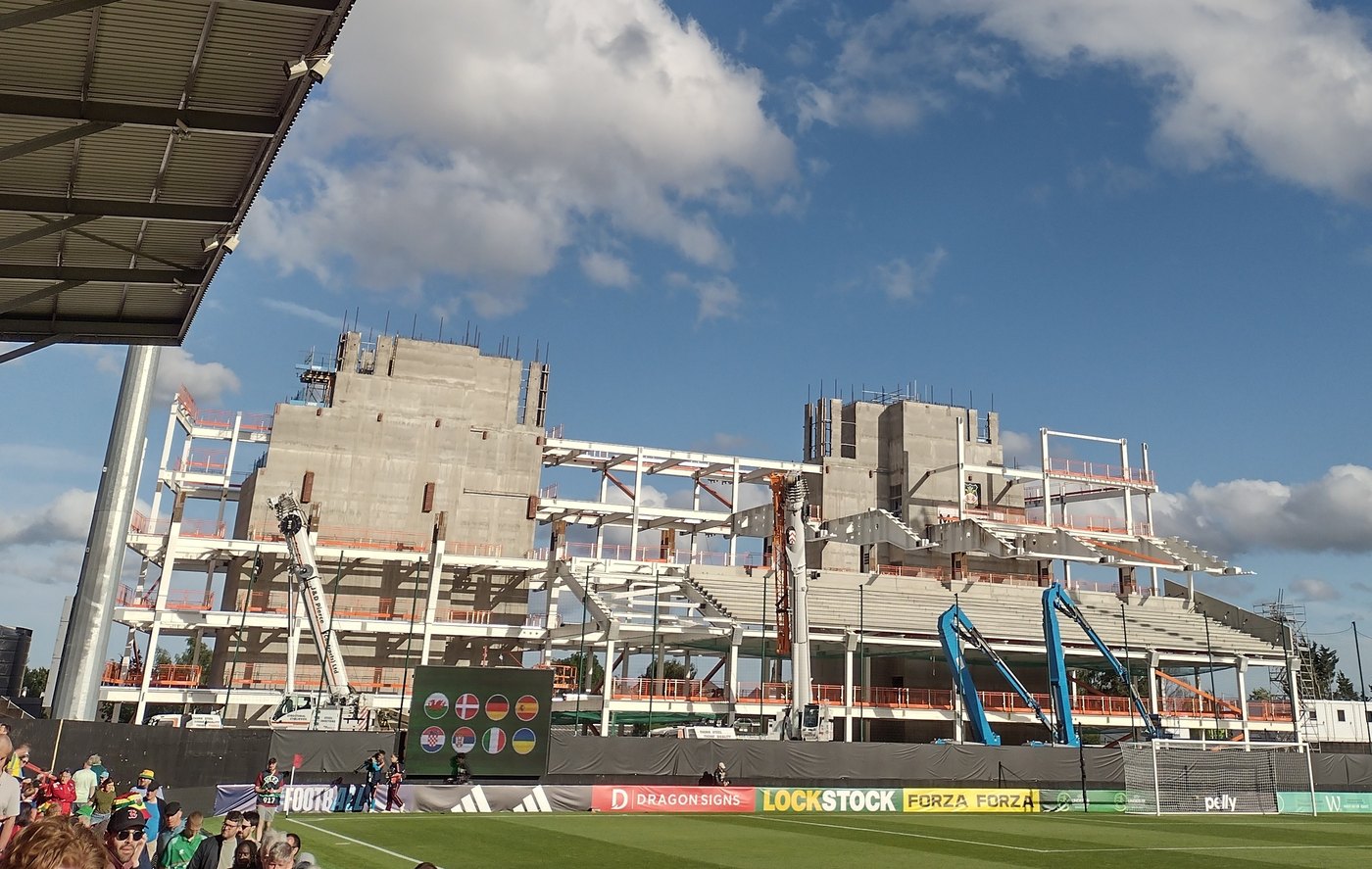
The Kop stand under construction at Wrexham’s Racecourse Ground, 28 June 2026.
Photo: Rhyswynne · CC0 1.0 · JPEG conversion and compression.

Madrid Budget for €707m of Wages and a 1% Margin
Real Madrid’s budget for 2026/27 sets wages at €707m, a club record and 57% of turnover. Total revenue is forecast at €1.405bn, also a record, with turnover of €1,250.2m up 4.7% and €154.8m expected from player sales. After all of that the club expects to make €14.2m, down from €26.3m. The biggest commercial operation in football is planning a margin of about 1%. Calcio e Finanza notes that the wage ratio would be nearer 60% were it not for the sale of VIP seats at the rebuilt Bernabéu. Madrid are now spending at levels that were once the preserve of Paris Saint-Germain.
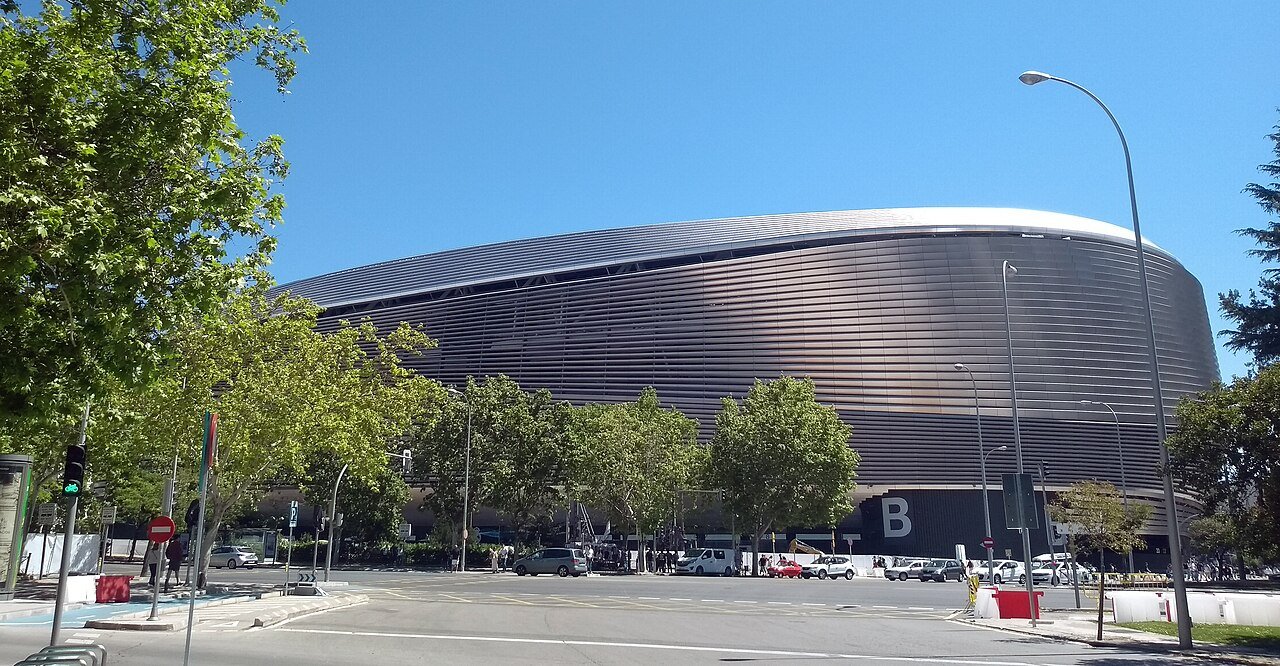
The west façade of the Santiago Bernabéu, Madrid, 21 April 2024.
Photo: Luis García · CC BY-SA 4.0 · JPEG conversion and compression.

A Year on the Nasdaq Has Cost Cádiz 93%
A year ago Cádiz CF became the first Spanish club with a subsidiary on the Nasdaq when Nomadar, its technology arm, started trading under the ticker NOMA. The idea was that Nomadar would raise about €285m to build Sportech City, a 110,000 m² complex at El Puerto de Santa María with a 40,000-capacity pavilion, a hotel, 20,000 m² of shops, a data centre and a technology incubator.
El Debate reported that the complex was expected to generate about €15m a year. LaLiga calculates each club’s salary limit from its recurring income, so revenue of that kind would raise the amount a second-division club is permitted to spend on players. In the past clubs have tried to lift the limit by selling assets or by selling future receivables for cash up front. Both yield cash without increasing recurring income, bringing only temporary relief. Conversely, a business generating revenue every year increases the limit permanently, precisely what Cádiz sought to finance on the Nasdaq.
On the anniversary of the listing the shares closed at $1.52, down about 93%, and the company was worth about $27m against roughly $312m on its first day. Cádiz hold 750,000 shares, received in exchange for a credit right against Sport City Cádiz and $1m in cash. The contract valued them at $7.5m and the market now values them at about $1.14m. The club’s unaudited accounts to 30 June still carry the stake at €6.47m.
Nomadar has disclosed conflict-of-interest risks arising from Rafael Contreras holding roles at both the club and the subsidiary and has announced new financing at lower prices than its earlier rounds. Construction of Sportech City has not started.
Marseille Asked the Players to Take Less. The Players Said No.
Marseille’s players have turned down a request from the club to accept a pay cut. The approach was first made at the end of October and rejected. On 5 November, according to Foot Mercato, sporting director Grégory Lorenzi returned with a revised proposal under which any player accepting a reduction this season would have his release clause lowered substantially, making a departure next summer easier and cheaper to arrange. No player has accepted it.
In June UEFA ruled that Marseille had missed the final target of the settlement agreement they signed in 2022. The fine was €10m, the registration of new players for this season’s European campaign was restricted and if the target is missed again this season Marseille will be excluded from the next UEFA competition they qualify for within the following three years. UEFA also found squad spending above the 70% ceiling in 2025.
Lorenzi’s request comes after a summer in which Marseille sold Mason Greenwood to Fenerbahçe for €39m and let Aubameyang, Nadir, Rulli, Medina and Aguerd leave. Frank McCourt has spent more than €700m on the club since 2016 and in one season alone covered losses approaching €100m. Romain Molina reports that McCourt has told people privately he no longer wants to fund the losses, while the search for a minority investor has so far proved unsuccessful.
Liked this?
Get the next issue in your inbox.
Free, twice a week.